
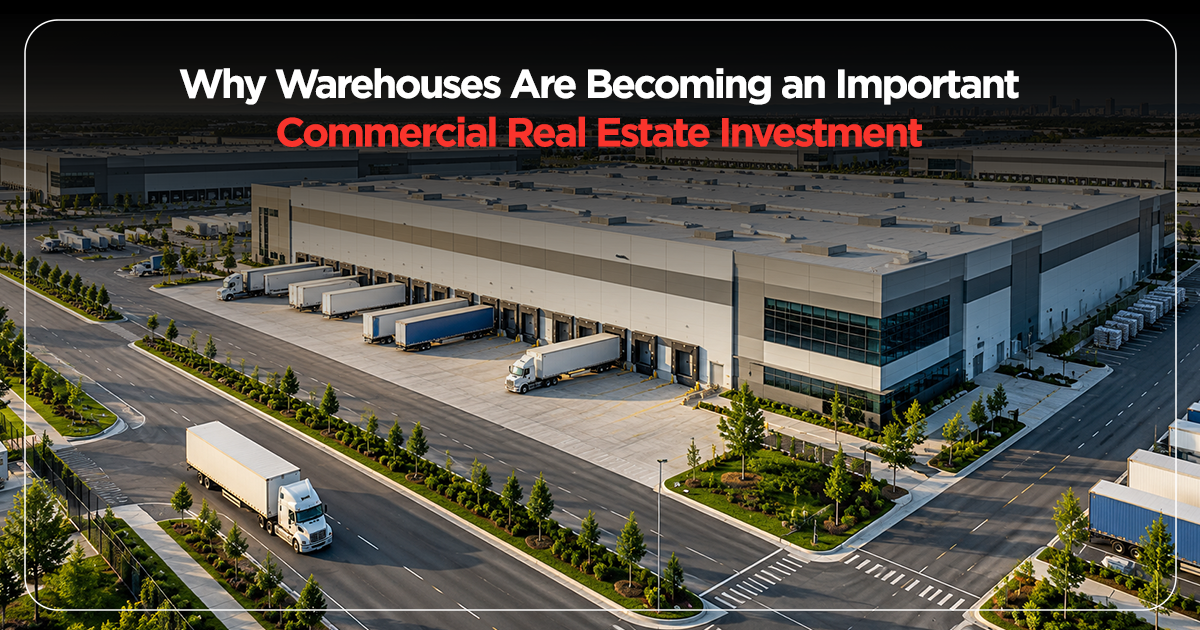
Warehouses are becoming an important part of the property market, because businesses need dependable spaces to store, manage, and send out their goods. Online shopping, manufacturing, retail, and organised supply chains are all growing, and that has raised the need for well-planned storage facilities. As a result, commercial real estate industrial assets are catching the eye of investors who want options beyond traditional offices and retail properties.
Residential properties depend on housing demand. Warehouses are different, because they serve business operations that need the right location, enough storage space, and easy access for transport.
If you are thinking about a warehouse in chennai, look closely at the location, road connectivity, industrial activity, and access to distribution networks. A well-placed commercial warehouse can attract businesses that need reliable storage and logistics facilities. Even so, it is important to check the property’s condition, its permitted use, the operating costs, and the local tenant demand before you decide.
The wider industrial real estate market includes warehouses, distribution centres, industrial sheds, and manufacturing facilities, and each one meets a different business need. When you understand these differences, it becomes easier to pick an asset that suits your budget and your investment goals.
Another reason investors are looking at warehouse investment is the chance to earn rental income through leasing agreements. That income depends on the demand from tenants, the terms of the lease, periods of vacancy and the management of the property.
The rise in investment in warehousing also shows how much businesses need organised storage and faster delivery.
According to Colliers, industrial and warehousing demand across India’s top eight cities reached 36.9 million square feet in 2025, which is 16% growth over the previous year. Chennai made up 22% of that demand. These trends help explain why investors are looking at commercial warehouse property for sale in well-established industrial and logistics areas.
Still, market growth does not mean every property will give good returns. Prior to purchase, evaluate the purchase price, quality of construction, legal documents, tenant requirements and maintenance expenses. Knowing this information can assist you in deciding the potential value against the risk of having a warehouse property.
The commercial real estate industrial sector offers businesses a place to store products, fulfil orders and ship goods. The ideal facilities enable companies to better handle their inventories and shipments.
Chennai is also an important centre for industrial and logistics activities. If you are searching for a warehouse in chennai, see to it that it is well connected to the main roads, surrounding industrial parks, transport centers and potential office space clients such as companies.
Study your regional demand for warehouse space before you invest. You should also research the local area, as some areas will let harder than others, so this will give you further insight on making a better investment out of the place.
A commercial warehouse has multiple uses such as for storing general goods, distribution of goods, inventory management and order processing.
When selecting a property, evaluate:
Storage space and floor plan.
Facilities for the movement of goods in and out.
Goods handling accommodation.
Vehicle access.
Power and utilities.
Building condition and permitted use.
The right format depends on the intended tenant.
Which warehouse is best depends on how the tenant is going to use the space and what the tenant’s day-to-day looks like.
Also Read: What type of commercial property is most profitable?
The industrial real estate is comprised of land and buildings used in production, warehousing, logistics, and distribution.
Know the difference between a warehouse, which is primarily for storage, and an industrial building, which can be used for manufacturing or other uses, before you invest. There can be varying levels of infrastructure, approval processes and maintenance costs for each type of property. It's a matter of how you intend to use the space.
A warehouse investment may yield rental income if the space is leased to a suitable tenant. However, the real returns are a function of the lease terms, the operating costs, and the rental rates.
Investigate the rental rates on similar properties, periods of vacancy, length of lease, cost of upkeep, taxes, and tenant's creditworthiness before you do your sums on the potential returns. Base your projections on conservative, realistic assumptions to get what the property could make rather than assuming all of the potential income.
The investment in warehousing for the market is expanding due to the growth in e-commerce, manufacturing, 3PL providers, and evolving supply chain requirements. Logistics and e-commerce activity has driven demand for new warehouses and investment-grade facilities, says CBRE's India Industrial and Logistics Outlook.
For investors, knowledge of what the local demand is and what types of warehouse space companies use can help to pinpoint attractive investment possibilities.
The location of a warehouse influences the ease of transportation of goods, the efficiency of business operations, and the cost of logistics for businesses.
Consider its connectivity to major roads, proximity to other industrial developments, access for trucks, availability of workforce and distance to suppliers and customers when you are looking for a commercial warehouse property for sale.
A cheaper property is not necessarily the better option. Transport costs can increase due to poor connectivity and it can be hard to attract tenants.
Also Read: Best Areas to Invest in Commercial Property in Chennai 2026
The commercial real estate industrial sector provides several routes for investment, however each building must be analyzed by what it costs and what it can make and possibly save you.
|
Factor |
What to Check |
|
Buying Cost |
Cost of purchasing the property, with associated fees |
|
Rent Income |
Rent levels for comparable properties nearby |
|
Vacancy |
Potential periods of vacant possession of the property |
|
Maintenance |
Cost of repairs, maintenance and day-to-day running of the property |
|
Terms of your Lease |
Length of the lease, the rent increases, conditions of renewals |
|
Liquidity / Exit Options |
Demand for resale and the ability to sell the property at a later date |
Before you invest, figure your expected rental income net of expenses. This gives you an idea of the potential returns for the property and helps you decide more confidently.
There are risks in the commercial real estate industrial sector such as vacant properties, tenant concentration, repair costs, loan payments and shifts in local demand.
The selling ownership, allowed use of the property, building permissions, rights of way and any related environmental issues should all be verified prior to purchase. Obtain the necessary legal and financial guidance to review the paperwork and analyze the investment.
The logistics real estate market is growing as companies increasingly need warehouses and distribution centers.
but fluctuates by region and is influenced by local legislation, building codes and general national economic situation.
Prior to buying, review government infrastructure plans and market reports. And check the developments that are planned to see if they've been approved, or if they're still just ideas.
A commercial warehouse for sale should be compared to similar properties in the market.
Building condition, floor space, loading, access, operating costs and probable tenant needs, etc., should be considered.
Do not make a decision based solely on the advertised price.
The warehousing demand in India is mainly contributed by logistics, manufacturing, retail, and e-commerce sectors. Yet, demand may fluctuate according to the warehouse location and type.
If you are looking for warehouse real estate investment , it may be a good investment. Look at local vacancy rates, leases, costs of ownership, and how easily you could sell later before you buy. Knowing these things will help you make a better decision.
Warehouses are for storage, distribution, manufacturing and e-commerce operations. There are potential leasing opportunities as companies require appropriate space to control inventory and supply their products.
It might be a good choice for certain investors, but the returns are influenced by the price paid, demand from tenants, length of the lease, how long the property is empty, cost of maintenance and the location of the property. Returns are not guaranteed.
The increasing e-commerce, manufacturing, organized retail, third-party logistics and changing supply-chain requirements have been major contributors to the growth of the warehousing demand industry in India.
The location of a warehouse determines its transportation cost, supplier and customer access, and ability to attract tenants. Prior to purchasing evaluate the road access, proximity to industrial parks, availability of labor, and level of competition due to other warehouses nearby.
The warehouse owners can profit by leasing their space to logistics firms, retailers, manufacturers and distributors. How much they make comes down to occupancy, the rental contracts and the maintenance and operating costs of the building.
Potential benefits: the rental income, the business user demand, and that space may be let for longer periods. The result is determined by market and quality of the property.
Before you buy, take into account the place, position, and size of the house. Also take into account the cost, the demand for rental, the upkeep, the term of the lease and the resale value.
They may be suitable for long-term investors, but demand and competition, maintenance, and tenant needs should be considered carefully.
Warehouse space is occupied by a broad array of industries such as logistics, e-commerce, manufacturing, wholesaling, retail chains and distribution where each warehousing customer utilizes the space to store inventory and handle the flow of products.
Warehouses are mainly used to store and ship products. In contrast, industrial properties can have activities such as manufacturing, assembly or processing. Some buildings are intended to do both.